One of the most common conversations I have with new clients goes something like this: they’ve done their research, they’ve looked at a few properties, and they come to me with a clear question: Should I focus on cash flow or capital growth?
It’s a fair question. But in my experience, the way it’s framed already reveals a gap in how they’re thinking about the market.
The Assumption Most Investors Bring to Dubai
In most property markets, cash flow and capital growth sit at opposite ends of a spectrum. You chase yield in secondary cities where prices are low and rents are relatively high. You chase growth in prime locations where prices are already elevated and the rental yield gets squeezed.
That tension is real in London. It’s real in Sydney. It’s real in most of the world’s major property markets.
Dubai, in many ways, doesn’t play by the same rules.
Why Dubai Changes the Equation
I often tell clients who are building their first position in Dubai, particularly those based overseas, to start with cash flow.
The logic is straightforward. A property that generates net income from day one doesn’t require you to fund it from abroad. It services itself. And if you’re early in your Dubai investing journey, that self-sufficiency gives you the stability to hold through any short-term market noise without being forced to sell.
The best cash flow opportunities I’ve seen tend to be in mid-market communities where the tenant pool is deep and consistent: expat families, young professionals, corporate relocations. Studio and one-bedroom apartments near metro lines and employment corridors perform particularly well. Short-term rental properties in tourist-heavy corridors like Dubai Marina or Downtown can push gross yields to 10-12%, though the management overhead is meaningfully higher and the income is less predictable.
Don’t get me wrong. High yield doesn’t automatically mean great investment. Some of the highest-yielding pockets in Dubai are in communities that are fully built out, with limited scope for price appreciation. The income is real, but you’re not building equity in a location that’s evolving. That’s fine if income is your primary goal. But it’s worth being clear-eyed about the trade-off.
Where the Growth Story Is Still Playing Out
For investors with a longer horizon and capital they don’t need to draw as income, the growth play in Dubai is genuinely compelling. But the window for entry shifts constantly.
The ultra-prime tier, Palm Jumeirah, Emirates Hills, Jumeirah Bay, has already seen its most dramatic re-rating. Branded residences from names like Four Seasons and Bulgari have attracted serious ultra-high-net-worth demand, and those prices reflect it.
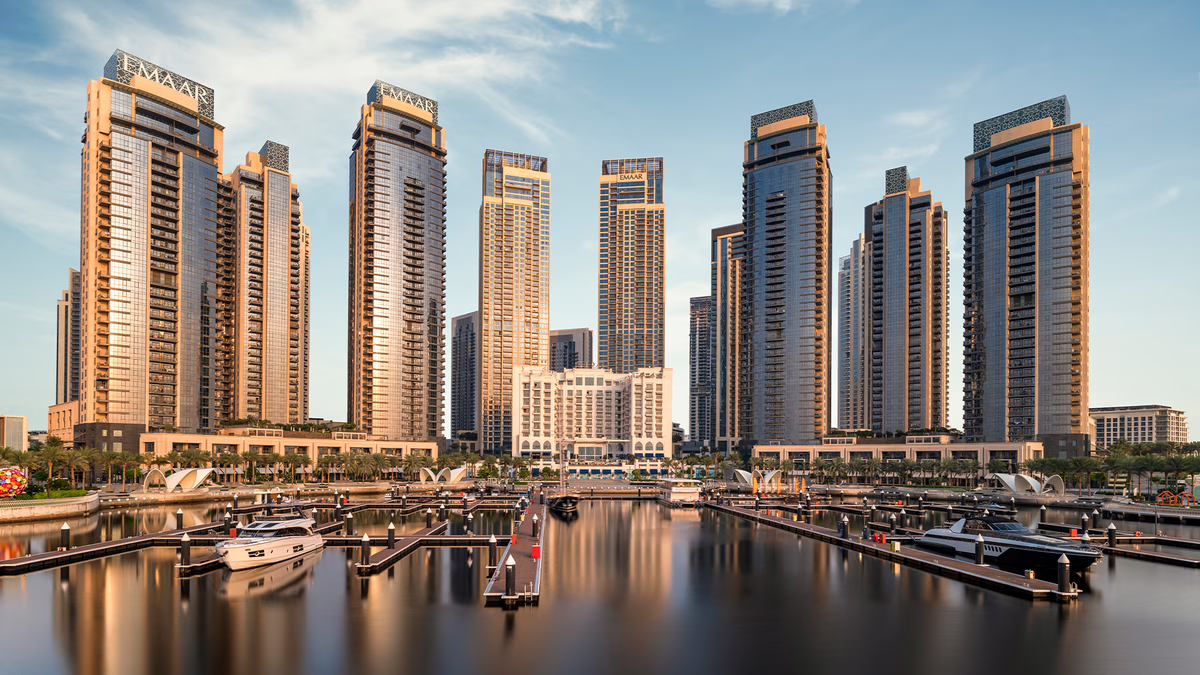
Where I find the more interesting long-term case today is in master-planned communities that are still early in their delivery cycle. Emaar Beachfront, Dubai Creek Harbour, and areas just beginning to benefit from major infrastructure investment are the types of locations where the asset and the surrounding community appreciate together. Rents rise as amenities complete. Values compound as the address becomes established.
Off-plan in these areas is a nuanced play. The yields look modest at today’s projected rents, and the risk profile is different from a ready asset. But for investors with the right risk tolerance and a genuine long-term view, the entry point and payment plan structure can make it one of the most capital-efficient positions in the market.
What I Actually Tell Clients
Here’s my honest view: the investors I’ve seen struggle in Dubai are rarely the ones who picked the wrong strategy. They’re the ones who didn’t pick a strategy at all, who bought on market excitement without being clear on what the asset was meant to do for them.
A client I worked with recently, an investor based in Europe building a multi-property portfolio, came in convinced he wanted maximum yield. When we mapped out his actual financial position, it turned out his living expenses were covered, his portfolio was generating income elsewhere, and what he actually needed was long-term wealth accumulation. We ended up placing him in a growth asset in a developing corridor, not a high-yield apartment in an established community.
The right answer depends entirely on where you are in your investing journey, not just what’s performing in the market right now.
So, Which Is Right for You?
If you’re building your first position in Dubai and need the asset to carry itself, lead with cash flow. Get the market experience, establish your track record, and reinvest from a position of stability.
If you already have income covered and you’re thinking in five-to-ten-year increments, a well-chosen growth asset in the right location is where meaningful wealth gets built.
And honestly? Many of the most effective portfolios I’ve seen in Dubai do both, using yield-generating apartments to cover holding costs, while positioning one or two long-term assets in high-conviction growth corridors.
The goal isn’t to choose between income and appreciation. The goal is to understand which one you need more, right now, and build a position that reflects that honestly.
If you’d like to discuss your investment strategy for Dubai, or would like to explore your options across the right asset types for your goals, please reach out to me directly at [email protected] or on WhatsApp at +971 58 588 4974.